CA (613) 212-2225 | US (720) 994-8779 [email protected]

How to Help Students with Dyslexia

October was dyslexia awareness month. The International Dyslexia Association (IDA) is having its annual conference today, called DyslexiaCon. Usually in the month of October or November, IDA plans its biggest event of the year, bringing together professionals, families, and those affected by dyslexia.

The early literacy community is involved in raising awareness about dyslexia that affects the reading ability of so many children around the world. 

In Canada alone, there are said to be over 750,000 dyslexic students. 

Sprig has previously written on how to build reading proficiency in dyslexic children. The article goes over the symptoms of dyslexia at various stages of early learning. It covers the characteristics of effective intervention, and features advice from reading programs that focus on dyslexia. Additionally, it explains the current state of dyslexia training for teachers. 

It is a must read for anyone interested in implementing reading best practices in the classroom. 

Regardless of the type and degree of training teachers have received on dyslexia, or their current level of knowledge, it’s never too late to create a more supportive learning experience for dyslexic students.

If you want to understand the basics of dyslexia and see proven characteristics of effective reading programs, do read Sprig’s Improving Reading with Dyslexia. 

This article is a follow up to that content, focusing exclusively on how teachers can support students with dyslexia. 


Helping Dyslexic Students- 4 Directives

Helping Dyslexic Students- 4 Directives

To maximize the reading potential for every child, including those with dyslexia, there are 4 things that need to happen.

  • A love for reading must be instilled early on.
  • The right learning environment must be provided.
  • First round of assessments should be done early.
  • Instruction should be direct and systematic at all levels of interventions.

The above four directives are further explored in the rest of the article. 


1. Make Reading Enjoyable

Dr. Cruger is a neuropsychologist at the Child Mind Institute. He says that typical tutoring may actually be harmful to a dyslexic early reader, especially if the experience is unpleasant.

He goes on to say that if a young student does not like the experience of reading help, the tutoring service will not be effective. 

A dyslexic child has to enjoy the experience of reading. Simply upping the dosage of practice will not help without offering positive reinforcements and encouragement along the way. 

Dr. Cruger recommends that teachers celebrate every small victory and accomplishment in the learning journey of dyslexic students. 


2. Offer Necessary Accommodations

Given dyslexic students need more support than the rest of the class, proper accommodations should be arranged for them so they don’t lose interest in the process of reading. 

Understood is a non-profit organization that offers resources for better understanding and dealing with learning differences such as dyslexia and ADHD. 

Understood’s former Director of Thought Leadership, Amanda Morin, offers tips on how to tweak classroom materials and routine to suit the needs of dyslexic children. 

Educators are asked to use coloured strips or bookmarks to make it easier for striving readers to concentrate on a line of text. They are encouraged to give detailed instructions and read aloud written instructions. 

The idea is to never leave a student in a state of confusion where they are too embarrassed to seek help. 


3. Address the Root Issue With the Early Assessment

The challenge in grasping foundational skills such as decoding is said to be the root problem of dyslexia. 

If this root issue is identified early enough, it is possible to mitigate the effects of dyslexia. It is why many states across the US have mandated dyslexia screening in early learning. Sprig considers the availability of such screenings important enough that it is featured as a question for state profiles in its interactive evidence-based early learning map

In a recent study by Maureen Lovett, Professor of Pediatrics and Medical Services at University of Toronto, learning outcomes for dyslexic kids were almost twice as good when interventions were delivered from Grade 1 to Grade 3. 

Early intervention is important for all children. But as dyslexic children require added support, their case for early intervention is even more acute.


4. Direct and Systematic Instruction at All Levels

As learning to read is an acquired ability, the brain needs a chance to learn about the relationships between sounds and letters. Most intervention methodologies follow a three tier system. 

Tier 1 refers to universal high-quality instruction for the whole classroom. Tier 2 refers to targeted intervention for small groups who need extra support. Tier 3 refers to intensive instruction for individual students. 

This framework applies very well to supporting dyslexic students, when it comes to matching the right instruction at each level. 

At tier 1, they are exposed to the acquisition of grade-level, fundamental skills that every student needs to learn reading, regardless of whether they have dyslexia or not. 

At tier 2 and tier 3, the progress of any dyslexic students is accelerated so they are able to efficiently bridge any learning gaps in order to participate in grade-level reading. 

So at all levels from the ground up, they are always scaffolded with extra support, beginning with inclusive whole classroom instruction with the possibility of in-classroom differentiated instruction. 

Such a direct and systematic approach to instruction ensures that any learning shortcomings are addressed in the beginning so every student can have their weaknesses addressed. 

In future years, greater support is provided so the dyslexic learner has the chance to work on their identified weaknesses while still being on route to reading at grade level, with age-appropriate reading materials. 


How Sprig Helps Dyslexic Readers
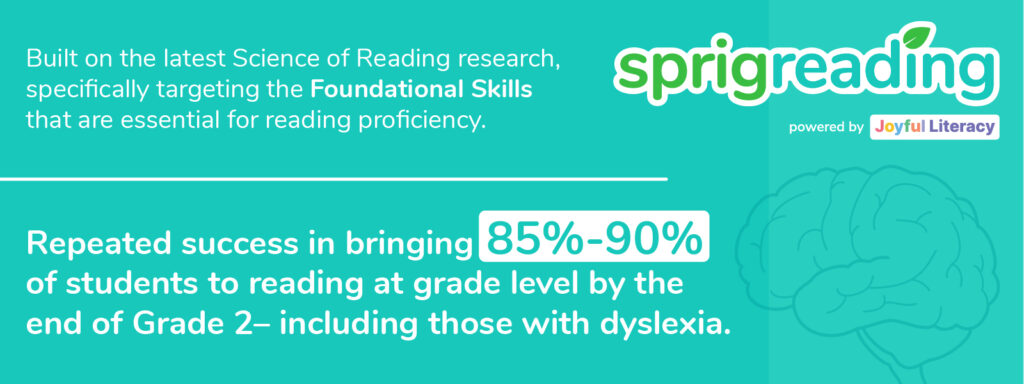
How Sprig Helps Dyslexic Readers

Unlike other children, dyslexic early learners often need more explicit instruction, intensive practice and targeted support. 

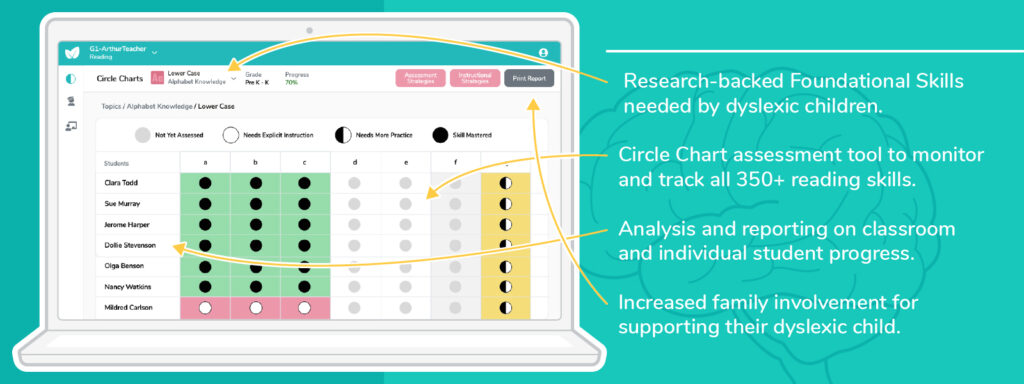
Sprig Reading: Powered by Joyful Literacy, provides ALL the assistance teachers, tutors and reading specialists need to make this possible.

Educators provide rigorous instruction and support to children with dyslexia by using an evidence-based and intuitive reading platform.
Sprig Helps Dyslexia

The planned scope and sequencing of lessons in Sprig Reading, together with its clear assessment and instructional strategies on foundational reading skill sets, provide a systematic literacy approach to helping all students with dyslexia. 

At the end of the day, dyslexia is very complex and new research on the reading brain continues to be published every quarter. 

But there is converging evidence on the type, frequency and timing of help dyslexic children need to receive. By adopting evidence-based reading strategies, it’s possible to boost the reading levels of dyslexic learners.


Why Guided Play-based Learning in Early Literacy?

Play-based learning is an approach to learning that maintains a child’s enjoyment of either free play or guided play while engaging with learning content. 

Free play is purely initiated and driven by the student, while guided play has some degree of teacher involvement.

In early literacy, play-based learning is proven to have a significantly positive effect on narrative language ability and grammar. 

Play-based learning with teacher guidance has been shown to raise phonemic awareness and phonics skills in kindergarteners. 

There is plenty of evidence to suggest that when literacy materials and teacher involvement are added to play-based learning, language skills improve significantly. 

With such a strong association between guided play-based learning and the advancement of early literacy skills, it’s worthwhile to explore the benefits of play-based learning, its examples and the extent of teacher involvement that constitute it. 

Play-based learning is one approach to differentiate learning— something Sprig has covered in a previous article showing how differentiated learning supports all other forms of learning

Indeed some children may display a greater preference for play. 

But by itself, play-based learning as a strategy for the whole classroom is a great way to improve early literacy scores.

Play-based learning supports early literacy development in multiple ways.


Benefits of Play-based Learning. How it Supports Early Literacy.

Benefits of Play-based Learning. How it Supports Early Literacy.


Directly Impacts Language and Reading Acquisition

Play-based learning enhances children’s literacy and language development. It allows children a chance to both learn and practice their newly acquired skills. 

Children are able to connect oral and textual modes of communication as they learn about  the structure and meaning of new words.


Drives Cognitive and Social Development which Moderates Language Development

Play-based learning engages all of early learners’ senses. It allows them to express their thoughts and feelings, investigate their surroundings, and make connections between what they already know and new information and abilities. Such cognition ability is helpful in learning how to read. 

As early learners playfully express themselves to their classmates and teachers, they bring their language, traditions, and culture into the classroom. Such healthy social development aids reading ability. 


Builds Learning Language Positivity

Just as there is a concept called positive identity as a math learner, the same concept carries over to language. A growth mindset is required to develop the confidence to improve reading skills. 

Including play in learning activities fosters a love of learning languages in kids. Children are more likely to learn and explore new literacy topics when they appreciate their learning environment. Including play in the classroom improves memory and new information retention — important factors in learning how to read. 


Provides Deep Understanding of the Required Components of Reading

Play-based learning evokes many other types of learning, such as inquiry-based learning, problem-solving, curiosity-based learning, etc. Working on all of these different types of learning is great for clarifying knowledge structures that ultimately lead to a deep understanding of language. 

Decoding words and understanding language are crucial for reading comprehension. A deep understanding of both processes can be grasped by direction instruction and play-based practice.


Examples of Play-based Learning

Examples of Play-based Learning

Examples of play-based learning need not be newly introduced to any early childhood or primary educator out there. They are so common in fact, that when listing them, one immediately recognizes their place in the classroom. 

Role-playing, drawing, using playdough, blocks and puzzles for learning activities, dancing and singing, are all considered to be a part of play-based learning. 

However, more so than just knowing these play-based activities, it’s important to understand how to engage in these activities. The next section describes what play-based learning looks like in action. 


Characteristics of Guided Play. Continuum of Student-driven and Teacher-led Play-based Learning.

Characteristics of Guided Play. Continuum of Student-driven and Teacher-led Play-based Learning

Guided play was distinguished from free play at the opening of this article, to demonstrate how effective play-based learning was when it had some level of involvement from the teacher, either as an organizer, observer or planner. 

But guided play should include some free play inside its structure in order for it to be truly classified as play-based learning.  

Dr. Angela Pyle, an early childhood education researcher from the University of Toronto says that guided play “starts with free play driven by the children and their imaginations, and ends with direct instruction, which is completely driven by the teacher.”


Guided play can be thought of as both student and teacher initiated. 

A child can initiate play by starting to play with an object. The teacher can then use the opportunity to teach literacy skills such as building vocabulary around the items that the child is curious about. 

But if the teacher creates centers in the classroom that are specifically made for play, then this whole process can be thought of as teacher initiated. 

High-quality classrooms use hands-on activities that are carefully planned by the teachers. The teacher can teach a child how to learn, instead of just what to learn. 

  Purposeful play experiences can be designed by teachers to create richer learning experiences that are better remembered and internalized by early learners. 


Guided play experiences are directed by the child and facilitated by the teacher. 

The ratio of direction and facilitation can be adjusted to ensure that the lesson plans are being met. 

It is chosen by the student, but teachers plan, observe and guide the whole experience. This type of educational experience is self-chosen by the student, but it is sufficiently process oriented. 


What Sprig Does with Play-based Learning

What Sprig Does with Play-based Learning

This article barely scratches the surface when it comes to the wonders of play-based learning! 

Primarily, it’s important to establish the specific link between play and early literacy. When this bond is understood however, there are many play-based strategies that can be explored. Some of them are codified in the Sprig Reading App, an interactive tool for Pre-K to Grade 2 teachers to implement evidence-based reading instruction.

To systematically instruct and practice hundreds of essential early literacy skills, a healthy amount of play is required in the classroom. Many actionable tips are showcased in the teacher training modules that are contained within Sprig Reading. 

The teacher has great responsibility in choosing the type of play-based activities and controlling their level of involvement to ensure that their students reap maximum benefits from guided play-based learning. 

For every foundational reading skillset, there are playbooks designed by former educators and researchers that have a demonstrable impact on improving those very skillsets. 

If done well, the play-based learning approach fosters the interest and curiosity of the students  through exchanges that are meant to challenge the students’ thinking.

Children who co-construct their early reading experience with classmates, apply what they learn to real-world situations and make significant discoveries while they work towards learning objectives.

For early literacy, this amounts to playing with word and language concepts to sufficiently develop the right skill sets in order to start reading. 

The Ideal Online Professional Development for the Reading Teacher

A typical teacher spends 68 hours a year on professional development (PD) activities. With the inclusion of self-guided professional learning and courses, this annual total jumps to 89 hours. 

While this adds up to over two weeks of PD in a school year, it’s very important to prioritize what teachers are learning to ensure that the professional learning meets their expectations.

This is especially true for literacy instruction in preschool, kindergarten and Grades 1 to 3, where there is strong impetus for evidence-based reading instruction. 

Sprig covered the role of PD in strategic reading instruction in a previous article. It’s essential reading for anyone looking to better understand the linkage between PD and improving early literacy instruction. The article goes into the components of effective PD for reading instruction, its examples and its expectations.

This article will talk about the role of online PD, how it connects with the real purpose of PD, and how such a format can be useful for evidence-based reading instruction. 

It makes a case for online professional development being suited to raise student performance because of the advantages it provides to the reading teacher. 

For clarification, in this article, both the classroom teacher and literacy specialists are referred to as the reading teacher.  The term encompasses anyone who is involved in teaching early literacy to children. 


Why Online Professional Development?

Why Online Professional Development

Not having enough time is cited by school leaders as the greatest challenge to offering PD. Almost three quarters of school leaders say that PD happens on district-wide days off that are reserved for teacher in-service training. 

There is definitely a time crunch that is experienced by school systems and by reading teachers. 

Everyone wishes for more time for professional development without sacrificing any time that can be spent with students. 

Online professional development has the potential to alleviate this pressure by offering both on-demand and live sessions. 

Irrespective of if they are live, or pre-recorded, these sessions would be quicker to attend, and need not clash with other responsibilities a reading teacher might have. 

Despite higher rates of satisfaction reported with online PD, only 30% of schools use it. There is scope for improvement here where schools can increase the flexibility and versatility of professional development programs.

Online PD programs are more flexible as they let teachers participate from wherever they are. They are also more versatile as they can be quickly put together to address a certain topic and can be watched at any time that is convenient to the teacher’s busy schedule. 


Legislative Purpose of Professional Development. vs Actual Need. 

Legislative Purpose of Professional Development. vs Actual Need.

Before further addressing the merits of online PD, what is the legislative purpose of PD? Answering this question can help us to better understand the current situation and how it can be modified to enhance instruction for reading teachers. 

Most states require teachers to renew their licenses to continue working in the school system. These requirements vary by state, and only 11 states have clear instructions regarding the purpose of the renewal. 

However, the majority of states mandate that educators complete some sort of PD, suggesting that they want the relicensing procedure to promote and validate continuous professional development.

The majority of states’ renewal requirements place a higher priority on the accumulation of time-based credits obtained through formal college coursework or more conventional PD activities like in-service days or seminars.

These short-term events can be disjointed, where there is no one goal binding them together. 

They are thus poorly aligned with teachers’ improvement needs.  

There is currently a dearth of the kind of sustained, targeted and personalized PD opportunities. Research suggests that PD opportunities with these characteristics are more likely to improve early reading instruction and student performance.


Sustained PD

It’s better to maintain a consistent professional learning schedule. 

Setting some time aside is recommended for PD. Large school districts set aside dedicated time for PD, such as New York City, which has built-in PD time on Mondays.


Targeted PD

It’s better to create PD programs that are in line with the school’s or state’s vision, or in line with the latest research on reading instruction, for example. 

It’s important to do a needs assessment on the professional learning needs of school teachers to implement research-based recommendations. According to a guide released by the Institute of Education Sciences, such needs assessment should include teacher self-reflection and classroom observations. 


Personalized PD

It’s better to design PD in a way which leaves room for personalization for the teacher. 

It should reach a balance between fitting the current standards around the existing teaching practices and tailoring the existing teaching practices to fit the current standards. 

The change that is asked for should not be rigid where teachers have to abandon their existing practice. Rather, it should have enough opportunities for personalization where the teacher can adopt new practices while still upholding their core practice.


How Can Online PD Be a Force for Evidence-based Reading Instruction?

How Can Online PD Be a Force for Evidence-based Reading Instruction

The online modality can help drive the sustenance, targeting and personalization of PD, which were mentioned in the last section.


It drives sustenance by continually collecting teacher feedback and preparing a series of PD opportunities that cover every challenge, need or learning area requested by the teacher. 

Such PD sessions are immediately useful for the classroom teacher due to the hands-on tactics that are taught, which can be quickly transferred to the class. They are also useful resources for discussions to be had at the school. 

The convenience and quickness of online PD ensures that a culture of continuous learning is set at the school. 


It drives targeting by creating a series of sessions that are pertinent to the challenges faced by the teacher. It offers helpful language for prompting and guiding readers to help students master the craft of reading. 

It gives teachers clear, succinct, and useful guidelines and materials for organizing and teaching developmentally suitable evidence-based lessons. 


It drives personalization through the ability to save PD sessions for later viewing. In this way, it’s a permanent resource for the teacher who can view and learn from it multiple times at their own convenience.

They can organize sessions in a way that is most applicable to their teaching needs at the time, and not be subject to a one-size-fits-all approach. 


Sprig Reading PD workshops ensure that reading teachers have the knowledge and tools required in order to excel at their professions. They are live interactive sessions which are announced on all our social media platforms and our newsletter.

Want to stay up to date with the latest early learning announcements and insightful articles? Follow us on our social media channels and subscribe to Root to Fruit, Sprig’s newsletter on all things early learning. 

Evidence-based Early Literacy Trends and Lessons (With Examples)

During this time of post-pandemic learning recovery, school teachers and administrators are working hand in hand to improve the learning experience for students. 

It’s in everyone’s best interest that students succeed! Especially when it comes to early literacy and math, proficiency in these two fundamental domains are the building blocks of success in learning and life.

Sprig Learning has worked in tandem with its education partners over the years to create early learning solutions that promote a culture of early literacy equity. 

It’s a time of great change, where new approaches and resources are being tried to teach early readers, such as evidence-based reading instruction and structured literacy teaching resources. 

The change process is usually preceded and followed by unfreezing and refreezing respectively. If this 2019 report from Education Week is any indication of the viewpoints held by the majority of educators, we are still at the unfreezing stage.

But the blow dealt by the pandemic to the continuity of in-school learning has definitely hastened the need to take action and speed up the change process. 

The learning loss that has occurred has grabbed the attention of many school districts and teachers across North America. Some have started to implement practices that are more conducive to evidence-based early literacy. 

Nine such evidence-based instruction trends are reviewed in this article, with examples. The lesson learned from each trend is discussed as well.

Evidence-based Early Literacy Trends and Lessons


Trend: Aligning Professional Development with Teacher Needs for Certain Grade Configurations

At King Elementary in West Contra Costa Unified School district in Richmond, California, the school leadership team focused on aligning various professional learning spaces to help teachers improve their reading instruction. 

Teachers in each grade were asked what type of professional development their grade level teams needed.

In lower grades, the focus was on phonics instruction, in middle grades the focus was on chapter books, and in the upper grades the focus was on project-based reading units.

Lesson

Before choosing professional development for the teaching staff, ask to see how it will inform their strategic reading instruction


Trend: Obtaining Buy-in From All and Keeping Everyone on The Same Page

Schools in Pella Community School District in Pella, Iowa, use a Reading Plus Partnership pledge that is an agreement among students, parents, teachers, reading specialists and principals to reach the highest educational objectives and strive for academic success. 

Parents are kept informed about all interventions. Everything is recorded to ensure accountability. Instructional procedures, materials, number of sessions, length per session, individuals involved, and follow-up notes are all recorded.

Lesson

Establishing collective ownership of literacy goals is a recommended action for increasing literacy equity, but if there is a system in place to check in on every instructional detail, it makes collaboration easier between the parties involved, including parents. Parental involvement is an established indicator of early reading success. 


Trend: Creating An Atmosphere of Play-based Learning

Jess Keenan, part of the K-1 faculty, at Waynflete Academy in Maine, stresses the importance of play-based learning. Kindergartners are naturally curious and eager to learn, which lends itself well to making choices in the classroom, playing with materials, and interacting with others to learn more about the world around them via language and math. 

The teacher has a responsibility to provide ample opportunities to students throughout the school day to engage with written and spoken language. In Jess’s words, “an approach to learning that is teacher-led and driven by student interest can be a powerful platform for learning.”

Lesson

Evidence-based learning is not at loggerheads with play-based learning. Both practice and play are needed, and they often complement each other. Explicit instruction needs to be practiced by students through play, where they can joyfully practice the learned concepts. 


Trend: Setting Time Aside for Foundational Skills

When focusing on learning recovery, sometimes the impetus is to catch up to grade level material as soon as possible. But in the process,  it is important not to gloss over the foundational skills. 

Students have to be ready for the next year, but not without mastering the grade level skills first. Mastering a skill is different from merely catching up to it at the level of your peers. Knowing this, the Public schools in Milwaukee have set a standard for their teachers, where time is dedicated to focus on prerequisite skills every day. 

Lesson

Each student is unique. This includes their ability to learn and retain information. If something is understood but not practiced enough times, there is a chance of forgetting it. Thus, setting aside some time to practice the fundamentals of literacy is most important. 


Trend: Sustaining Small Group Instruction

Evidence suggests that tutoring in small groups is beneficial over time, regardless of the environment or circumstance the students are in. Research published in 2021 by Brown University’s Annenberg Institute for School Reform showed that consistent tutoring sessions can accelerate learning by two to 10 months.

The Bristol Tennessee City Schools (BTCS) has partnered with the Niswonger Foundation to deliver high-dosage and high-impact tutoring in literacy and math. BTCS will be reimbursed for its tutors’ and project coordinator’s salaries, as a part of this program. 

Lesson

Differentiated instruction as a strategy in early literacy is widely known. When such a practice is sustained over time, the students in smaller groups reap the benefits. Whenever there is a scope of personalized learning, the class should be split into smaller groups. This will however require regular formative assessments.   


Trend: Reallocating Time Blocks Based on Need

Tennessee’s Haywood County Schools (HCS) allocated a 45 minute daily intervention time slot reserved for students to work on a variety of skills, to the studying of foundational skills for all students.  Reading proficiency levels in Grade 3 at HCS jumped from 8% to almost 26% within the span of a year.

Lesson

Depending on the situation, it can be helpful to consolidate various types of interventions into one lesson for the whole classroom, that is designed to master the basics, and thereby reduce the likelihood of future interventions. Again, understanding the classroom profile is key here. 


Trend: Providing Intensive Instruction to Test Student’s Maximum Learning Potential

Juan, a Grade 2 student at an undisclosed elementary school, only knew half of the consonants and none of the vowels of the alphabet. Despite his assessment results reflecting that of a special needs student, he made fast progress in one school year where he moved up two reading levels. This sudden jump was a stark contrast from his prior two years of stagnation. 

It was the result of an intensive phonics intervention applied by his teacher who had received dozens of hours of training in several different research-based reading programs.

Lesson

Sometimes, progress, or lack thereof, is not steady. It can happen in spurts. By not underestimating the capabilities of the student and providing intensive instruction, young learners can quickly be brought up to speed. 


Trend: Aligning Intervention with Curriculum

Ethel I. Baker Elementary School in  Sacramento City Unified School District has What I Need (WIN) Classes, which consists of 45 minutes of  daily structured literacy intervention using a curriculum that is strong on phonological awareness, phonics and sight words. 

Many students who were lagging behind have moved up one grade level throughout the course of a school year. Proficiency in listening, reading and speaking have all improved since the introduction of the program. 

Lesson

Reading intervention is critical in the success of early readers. It matters if the intervention is for foundational skills, the mastering of which will form the building blocks of reading proficiency. Thus when choosing an ideal reading intervention program, it’s important to see what type of curriculum it adheres to. 


Learning Lessons From Early Literacy Trends

Learning Lessons From Early Literacy Trends

There is a lot to learn from those teachers and staff who have taken the bull by the horn when it comes to starting early literacy initiatives. They have started to implement evidence-based early literacy practices.

It’s always good to have the right plan, but sometimes the urgency of a situation forces action before a plan. 

The efficacy of school improvement plans is not universally agreed upon. According to a RAND Corporation survey, only 44% of teachers and 67% of principals believe school improvement plans change teaching practices. 

In order for such plans to be effective, teachers need to be involved in the strategic planning. However, Less than half of the teachers surveyed say that strategic planning is a collaborative project in their school. 

Sprig hopes that these evidence-based early literacy trends started by teaching teams at schools inspires new thinking. By looking at the results they have delivered thus far, a far broader application of these trends are warranted.

7 More Actions Schools Can Take Today to Increase Early Literacy Equity

A couple of weeks ago on the Sprig Blog, 10 actions to increase literacy equity in schools was covered. It’s a highly recommended article for those who want to take action to address the existing literacy equity gap. 

The effort to reduce literacy inequity is a massive undertaking. It’s one that requires multiple actions. The original research conducted to write that piece included more than 10 ideas! Thus, as a part two of the same series, Sprig Learning presents to you, “7 More Actions Schools Can Take Today to Increase Literacy Equity”.

These 7 actions are just as applicable and research-based as those mentioned in the first part of this series. Sprig hopes some of these (if not all), are incorporated into future school improvement plans


Actions to Increase Early Literacy Equity

Comprehensive Instruction for Each Student to Increase Literacy Equity

1. Strengthen Instruction Using What Has Been Proven to Work

For literacy equity to flourish, it’s important that every student has access to  high-quality instruction rooted in evidence-based research.

For example, introducing phonics and phonemic awareness early on is a recommended practice for boosting literacy achievement. The National Reading Panel reviewed 52 studies of phonemic awareness instruction and 38 studies on phonics instruction to find that they produced positive effects on early literacy development, especially when applied in kindergarten and grade 1. 


2. Ensure Professional Development Is Aligned to Evidence-based Reading Instruction

With a push towards structured literacy that places an equal emphasis on both knowledge and practice of reading, it’s important that preservice teachers receive the right training. But as some of the preparatory programs have not revised their syllabus yet, the professional development (PD) offered by schools and school districts must bridge the gap and effectively train all educators. 

When PD sessions address strategic reading instruction that is backed by extant research, educators are in a better position to address literacy inequity. Educators get access to new information which they can use to optimize their existing teaching practice. It’s also an opportunity to review and align the vision of the school to mitigate literacy inequity. 


3. Create a Culture of Literacy by Explaining What is being Taught

To progress towards literacy equity, it’s important to include young learners in discussions of what is working versus what is not. They need to understand all that is being done, and why it is being done, i.e. to provide themselves the best chance to succeed as an early reader, and in life.

The What Works Clearinghouse is an initiative of the Institute of Education Sciences that acts as a trusted source of scientific evidence of what works in education. It reviewed the literacy achievement literature to find 10 studies showing significant association between motivating and engaging instruction and the improvement of students’ reading comprehension. 

It was recommended that the purpose of each lesson be explained, as well as the utility of various comprehension strategies. Students felt more confident knowing that what they were learning would help them to read. 


4. Improve Kindergarten Readiness using Data and Outreach

In an article published by the  National Conference of State Legislatures, it says that prekindergarten standards should align to each state’s K-12 standards. In this way, kindergarten readiness is improved, which is a major factor in determining early literacy equity. Sprig created an evidence-based early Literacy resource map for the US, where one of the questions answered for each state is if the state connects birth to age 5 data with K-3 education. 

To address literacy inequity at its root, kindergarten readiness must improve. Where applicable, schools and the community as a whole can offer a helping hand to parents with either knowledge or learning resources. This can increase parental involvement, which is a big indicator of early reading success. 


5. Use Appropriate Differentiated Instruction Measures

In a report by Northwestern Evaluation Association on data-powered strategies for literacy development, the use of data to differentiate learning is highlighted throughout the main points. Sprig has written at length about the virtues of differentiated instruction (from the teacher’s point of view) and personalized learning (from the student’s point of view).

Among many of the positive qualities of differentiated instruction, its ability to mitigate literacy inequity is very potent. Having data of each student makes a world of difference in tailoring instruction according to each student’s needs and abilities. Teachers are able to optimize instructional groups and lesson plans for their classrooms.


6. Provide Developmentally Appropriate Assessments

All early literacy researchers recommend the use of age relevant or developmentally appropriate assessments. Assessments provide valuable data that can be used to identify students who need extra support, and also inform instruction. 

It increases all around accountability in the school when there are enough detailed formative assessments. In order to increase literacy equity, there needs to be a working system that monitors the progress of every student. For different terms at each grade level, there should be a baseline expectation of where each student is on all of their foundational reading skills.   


7. Develop an Effective Intervention Strategy

Interventions should be applied early and as often as necessary to ensure young learners understand the concepts that are required of them to become a strong reader. Thus, early interventions must be modified to suit the specific skills and knowledge that is appropriate for each student. 

Applying an intervention strategy requires careful deliberation over the needs of both teachers and students, and the capabilities of the school itself.  It’s not as easy as picking an intervention program and expecting greater literacy equity, regardless of the current circumstances. But after a proper needs assessment is conducted, a cost-effective and evidence-based intervention strategy is one of the best ways to narrow the literacy gap. 


Comprehensive Instruction for Each Student to Increase Literacy Equity

Comprehensive Instruction for Each Student to Increase Literacy Equity

There is an increase in the discussion regarding what is the right approach to early literacy, analyzing both a structured approach and a balanced approach. It’s important to keep in mind that it’s ultimately the reading results that determines the efficiency of an approach. 

So it’s crucial to not leave any stones unturned when checking if a certain addition to instruction would have made a difference in early literacy achievement. In this regard, it’s good to be as comprehensive as possible when planning instruction. 

Kymyona Burk, a senior policy fellow at ExcelinEd and former elementary school language teacher, says that the focus should be on language acquisition and comprehension in the early years, where the teachers “explicitly and systematically teach their students how to decode”. Alongside phonics and word recognition, she also vouches for sentence structure and vocabulary. 

When reading instruction covers all the bases that are recommended by research, the likelihood of a student achieving reading mastery increases, regardless of their current situation. When actions like those recommended in this article and the prior article of the series are taken, it greatly benefits every early learner.