
Welcome to Part 2 of the UFLI Progress Monitoring Blog Series. In this instalment, we explore the critical role of classroom literacy resources and activities that align with the UFLI Foundations curriculum.
In Part 1, we established the importance of digital progress monitoring and highlighted UFLI’s unique position as an evidence-based curriculum.
When UFLI lessons and their associated reading skills are systematically monitored, it generates a substantial volume of data– essential for informing assessment, guiding instruction, and supporting targeted intervention.
But data alone is not enough.
As part of effective instructional planning, teachers prioritize the use of evidence-based literacy resources and activities to ensure their teaching is both targeted and impactful.
This blog examines how aligning these elements to the UFLI Foundations curriculum enhances their impact.
It also explores how thoughtfully designed resources and activities can complement existing UFLI materials, strengthen instructional delivery, and improve student learning outcomes.
Finally, this blog sets the stage for the concluding part of the series, where we will bring together data, resources, and instructional decision-making into a cohesive approach to literacy success.
Resources That Are Aligned to The UFLI Curriculum

Instructional resources are the materials teachers rely on to deliver, reinforce, and extend learning.
There can be many types of resources such as printable worksheets, cards, manipulatives, charts, workbooks, etc.
Resources signify something more than simply printing worksheets. They are meant to be used intentionally, with off-screen, multisensory approaches that actively engage students.
Through movement, sound, and hands-on interaction, they help strengthen the brain pathways needed for reading development.
When aligned to the UFLI scope and sequence, resources become far more than supplemental teaching aids. They become intentional supports designed to teach specific foundational reading skills.
Aligned resources help ensure that students are consistently exposed to the same concepts being taught.
They also allow for practice opportunities that directly reinforce targeted foundational skills.
For example, if a lesson focuses on a specific phonics skill, aligned resources might include:
- Decodable texts that emphasize the targeted skill.
- Visual aids such as anchor charts tied to the skill.
- Worksheets that enable practice of the taught concept.
Without alignment to a research-based scope and sequence, even high-quality resources can create disconnects.
Students may practice skills that are either too advanced, not yet introduced, or unrelated to the current focus, reducing the effectiveness of both instruction and assessment.
Aligned resources ensure that every interaction with text or task is purposeful and connected to the intended learning goals.
Activities That Are Aligned to The UFLI Curriculum

While resources provide the “what,” classroom activities define the “how.”
They shape how students engage with foundational reading skills during instruction.
Activities can be used in whole-class, small-group, or individualized instruction settings. They can also be personalized based on student assessment data, ensuring each learner gets the right instruction, at the right time, at the right level.
Effective literacy activities aligned to UFLI are:
- Systematic: following a logical progression.
- Focused: targeting specific foundational skills.
- Efficient: allowing for quick checks of understanding.
These activities create opportunities for embedded progress monitoring, where teachers can observe skill master over time, and see the transfer of those skills to new words and passages.
For example, for lessons focusing on phonological awareness, aligned activities might include:
- Phoneme–grapheme mapping.
- Blending and segmenting routines.
- Clap syllables in the word with matching props.
When activities are aligned, assessment becomes natural and continuous, rather than something separate or occasional.
They serve a more primary role in planning instruction, in providing instructions on how to use an existing resource covered in the prior section, like printable worksheets or flashcards.
Sprig Reading: A Digital Repository of Classroom Activities and Resources

Sprig Reading includes a growing set of embedded classroom resources and activities designed to support the teaching and assessment of foundational reading skills.
These are accessible directly within the platform, allowing educators to move seamlessly from instruction to practice to observation without leaving their workflow!
Importantly, these resources and activities are not intended to replace the lesson resources found in the UFLI Foundations Toolbox or the instructional activities mentioned within the UFLI Virtual Teaching Resource Hub.
Instead, they are designed to complement them through 1) Intentional Mapping, 2) Greater Choices, 3) Flexibility of Materials, 4) Availability of Added Guidance, and 5) Ability to Create and Share.
1. Intentional Mapping of Materials to UFLI’s Scope and Sequence
With Sprig Reading, teachers have an inventory of evidence-based resources and activities at their fingertips. As they work through UFLI lesson by lesson, aligned resources and activities are already built into the platform.
There is no need to spend time searching for them or second-guess alignment. Everything is intentionally mapped and ready to use when needed.
2. Greater Choices of Materials Designed for Classroom Use
With its continually expanding library of engaging resources and activities, Sprig Reading gives UFLI teachers even more ways to provide meaningful practice across every foundational reading skill.
The resources are all original, downloadable and printable, designed for classroom use and the instruction and assessment of foundational reading skills.
3. Flexibility of Materials for Greater Utility
Sprig Reading contains many flexible activities which can serve the dual purpose for quick skill checks or reinforcing a taught concept.
This allows for teachers to exercise their judgment in how they want to use a certain activity that best serves the unique needs of an individual student, or groups of students.
4. Availability of Added Guidance for More Support
Additionally, the reading skills are paired with instructional and assessment guidance, which provide more context on how to use the resource, or apply the particular activity.
5. Ability to Create and Share
Sprig Reading provides the opportunity for teachers to share new activities they have developed and which have been proven to work well in their classrooms.
Furthermore, teachers can choose to share their activities with other teachers within their school district and/or with all teachers across the world that use Sprig Reading.
Bringing it All Together: Resources and Activities in A Digital Progress Monitoring Environment
All of this within a digital progress monitoring environment, where teachers can do all of their work in one place when digitally monitoring progress of every skill in UFLI’s scope and sequence.
By working alongside UFLI’s existing resources, Sprig Reading helps create a more connected instructional experience, where teaching, practice, and visibility into student learning are closely aligned and monitored!
Furthermore, Sprig Reading is designed to personalize instruction for every student. By analyzing UFLI assessment data over time, it recommends targeted activities and resources for students, whether that be in a whole class, small group and/or individualized instruction setting.
Looking Ahead to the Final Alignment Picture
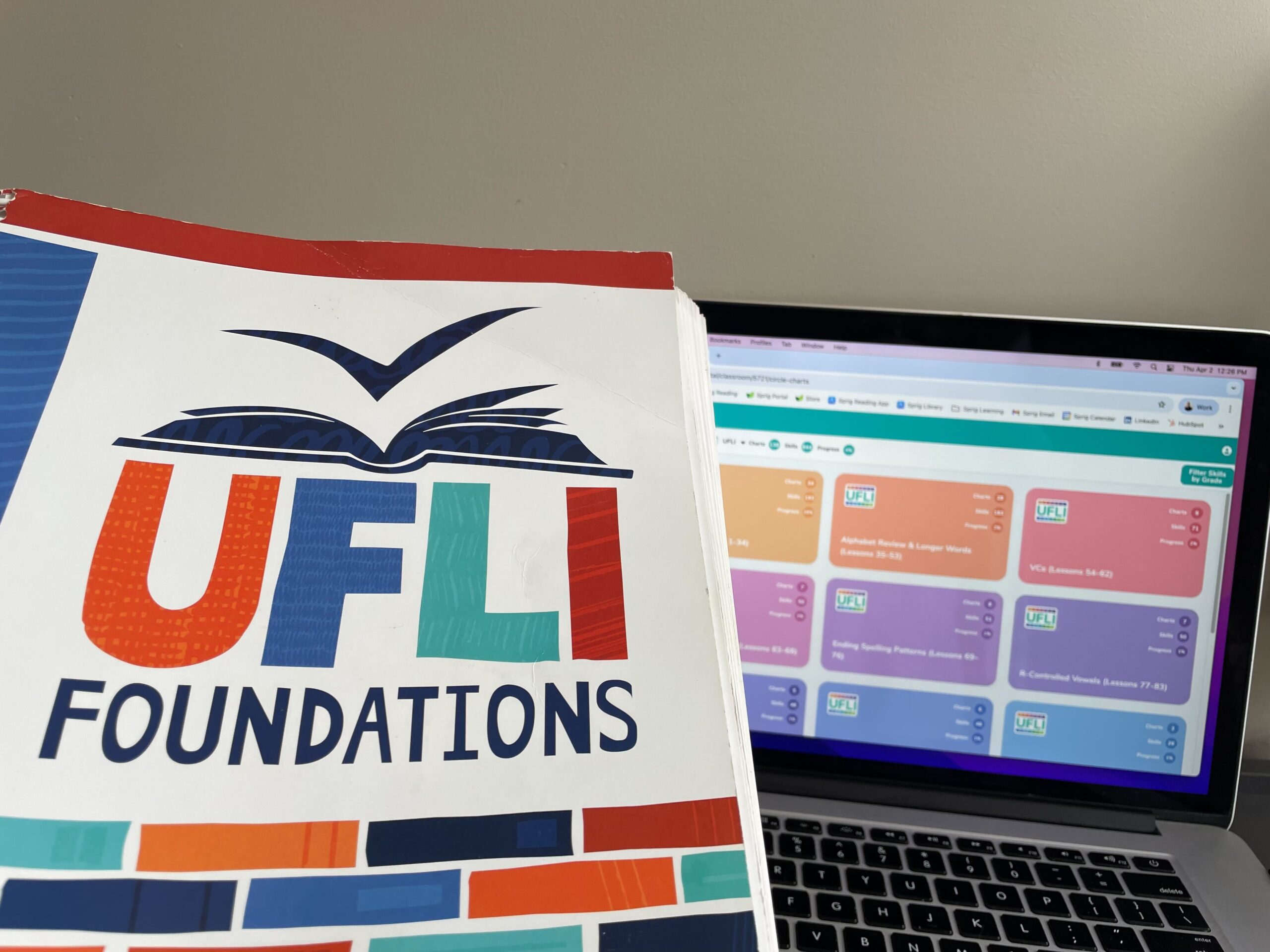
UFLI Foundations and the UFLI Foundations manual are the property of the University of Florida Literacy Institute©. All rights reserved.
It is powerful when teachers can digitally monitor student progress across all reading skills within the UFLI Foundations curriculum, ensuring that data is consistently captured and paired with aligned resources and instructional activities.
This creates a more coherent and effective classroom experience, where instruction, practice, and assessment are tightly connected.
However, student and classroom-level insight is only one part of the picture.
For school and district leaders, there is tremendous opportunity in zooming out to view this data system-wide.
This includes identifying trends, evaluating instructional effectiveness, and making informed decisions about resource allocation and intervention strategies.
When progress monitoring data is aggregated across classrooms and schools, variability in instructional impact can be identified and cohorts requiring additional support can be prioritized.
At the district level, this same data enables leaders to allocate resources more strategically (for example, staffing, interventions, professional development). It also helps to evaluate the implementation and effectiveness of existing tools and policies.
Research shows that data-driven decision-making in education is most effective when it operates as a continuous and iterative process, that is, collecting data, analyzing it, acting on insights, and evaluating outcomes over time.
In Part 3 of this series, the focus will shift to how school leaders can use progress monitoring data to inform instructional decisions at the school and district level.
Align with UFLI’s Scope and Sequence