Early literacy is the cornerstone of a child’s educational journey. It’s the point where the magic of reading and comprehension begins.
In its early stages, educators are aware of the significance of assessing a child’s reading skills. It helps them identify their strengths and areas that need improvement to become strong and confident readers.
Equally crucial is the ability to provide small group instruction in the classroom, driven by the results of these formative assessments.
It’s one thing to assess how a classroom is faring on the foundational reading skills– if they have been assessed, if they need explicit instruction, or if they need more practice.
It’s another thing to then have the means to provide differentiated instruction to all children in the classroom.
This article will explore the lead up to small group instruction from assessment, describe the advantages of small group instruction, and finally discuss the potential for synergy between assessment and small group instruction.
Assessment: The Starting Point

Assessments play a vital role in early literacy education.
Formative assessments help educators to diagnose specific foundational reading skills and monitor progress of every early learner in the classroom.
Furthermore, they enable educators to intervene early for students requiring additional help beyond core instruction, like those in tier 2 instruction, which provides targeted support to specific student groups.
But assessment is only part of the teaching process.
It is also critical to use that assessment data to inform and shape the reinforcement of instruction, increasing the intensity or specialization of instruction (may require the involvement of more than one role), further practice, and reassessment.
Some assessment solutions pride themselves in assessments alone, which is no doubt a necessary part of early literacy. But in order to enhance student learning and optimize early literacy practices, tools should include functionalities that support teachers to act upon student assessment data.
Often, this looks like the enablement of small group instruction.
The Power of Small Group Instruction
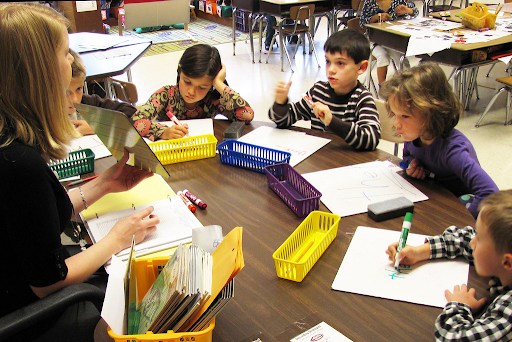
Once diagnostic and progress monitoring assessments are completed, small group instruction can immediately come into play.
This personalized approach to learning involves working with a small group of students who have similar reading abilities and needs.
Here’s why it’s so important:
Smaller Groups Allow More Targeted Support
Small group instruction allows educators to address specific reading challenges.
Whether it’s decoding, fluency, comprehension, or vocabulary, teachers can better tailor their instruction to meet individual needs when working in smaller groups, which would otherwise be difficult in large classrooms.
Smaller Group Instruction is a Tried and Tested Method for Differentiated Learning
The practice of differentiated instruction is a big topic by itself, and one that is covered extensively by Sprig.
Small group instruction is one of the most common ways to provide differentiated instruction to a classroom of students.
All students are never at the same point in their reading fluency and comprehension, at the same time.
Small group instruction enables educators to differentiate their teaching. They can provide more support for struggling readers while offering enrichment for advanced readers.
Smaller Groups Enable Individualized Feedback
Educators are passionate about teaching and prefer to dedicate their time to instruction rather than being overwhelmed with administrative tasks.
In smaller groups, educators can provide more personalized feedback for students. This helps children better understand their learning strengths and areas for improvement, fostering a closer relationship with their teachers.
Smaller Groups Increase Engagement
Many states and provinces across North America are implementing evidence-based reading instruction policies. There is enough proof to show that when such instruction is delivered in play-based settings, it helps early learners engage with the lessons and retain the taught concepts.
Smaller settings are less intimidating for some children, leading to increased participation and engagement. This supportive environment is conducive to building confidence.
Smaller Groups Result in Finer Progress Monitoring
Educators can monitor students’ progress in small groups with more attention, especially knowing the context of how that group was formed. As students advance in their reading skills, instruction can be adjusted to align with their development.
Educators should continuously monitor the progress of the whole classroom, that is, each individual student.
However, by grouping students by knowledge and/or specific skill level, teachers can enhance progress monitoring for that specific group of children.
Smaller Groups Lead to More Peer Interaction
Students in small groups can benefit from collaborative learning experiences. They can interact, discuss ideas, and learn from their peers, which adds a social dimension to their education.
Small group instruction encourages peer interaction. Students can learn from each other, ask questions, and engage in discussions, which enhances their understanding and love for reading.
The Synergy Between Assessment and Small Group Instruction

A strong bond between assessments and small group instruction creates synergy in early literacy education.
Using small group instruction is powerful by itself, but when combined with assessments, the two complement each other very well.
Small group instruction is enriched by assessment data. These small groups in turn provide insights for continuous assessment, or progress monitoring. Here are the ways small group instruction benefits from assessment data.
Small Group Instruction’s Flexible Grouping Delivers Timely Support
New Assessment Data Can Inform Groupings.
Unlike fixed small groups, flexible grouping allows students to work with various peers based on their current and evolving learning strengths, needs and interests.
Educators can create groups for specific activities or projects, based on the learning needs of the students. Groupings can be constantly updated based on incoming assessment data specific for each child.
Small Group Instruction Helps Every Student Through Adjusted Support.
Assessment Data on The Foundational Skill Acquisition Trajectory Can Inform Groupings.
In this approach, students receive unique work based on their readiness and interests.
All students cover the same essential skills or concepts, but the contents are adjusted in complexity or content.
Sometimes, students within a given time frame may exhibit varying learning paces. To prevent any child from falling behind, it’s crucial to provide explicit instruction to all groups albeit with various degrees of difficulty, rather than avoiding teaching one concept to all students at one time.
In these situations, it’s beneficial to create distinct groups to ensure that all students stay on track with their learning.
Small Group Instruction Allows for Group Efficiency Through Personalized Support.
Teachers Can Dictate Terms Using Incoming Assessment Data.
Of course, small group instruction is not the only means of differentiated instruction.
There are also other strategies, such as choice boards and tiered assignments, where students can choose what to to work on, or given an assignment with varied levels of support respectively.
But these strategies are often used for practicing learned concepts. They don’t have the type of teacher supervision in small groups, where both explicit instruction and practice can take place. Incoming assessment data helps teachers dictate terms in forming the right groups.
The Wonders of Small Group Instruction

In conclusion, early literacy assessments are the first step in understanding a child’s reading abilities, but small group instruction is the bridge that can help them cross over from emergent readers to proficient readers.
Small group instruction is often preferred because it has such natural synergy with assessments! It combines personalization, adaptability and efficiency to create a learning experience that can significantly benefit students.
When educators combine the assessments with the power of small group instruction, they create a learning environment that nurtures confident, capable, and enthusiastic young readers!
How do you form effective groups in your classroom? With Sprig Reading 4.0, you can view notes, pictures, and videos alongside assessments of every reading skill, helping you create the most relevant and targeted small groups.
Sprig Reading 4.0