
The first month of school sets the tone for the entire year. Depending on your district calendar, you may be just a couple of weeks into the school year, or already approaching the one or two-month mark.
You’ve likely spent time planning lessons, attending professional development days, and gathering new resources to support your students. But are you covering all the strategies shown by research to have the greatest impact on early literacy success?
This hectic time of year often leads teachers to make plans, only to get swept up in the daily demands of the classroom. As a result, some priorities may receive less attention, or be set aside altogether.
But it doesn’t have to be that way. By focusing on what’s most important early on, you can set the tone for a successful year for your students and for your classroom.
This blog highlights five evidence-based early literacy strategies teachers can implement right away. These time-tested back-to-school reading practices consistently lead to stronger literacy outcomes.
Some may already be part of your practice, while others might serve as timely reminders. Together, they’ll help you create a strong foundation for reading achievement for your students.
Jumpstarting Reading Success with These Five Back To School Literacy Strategies

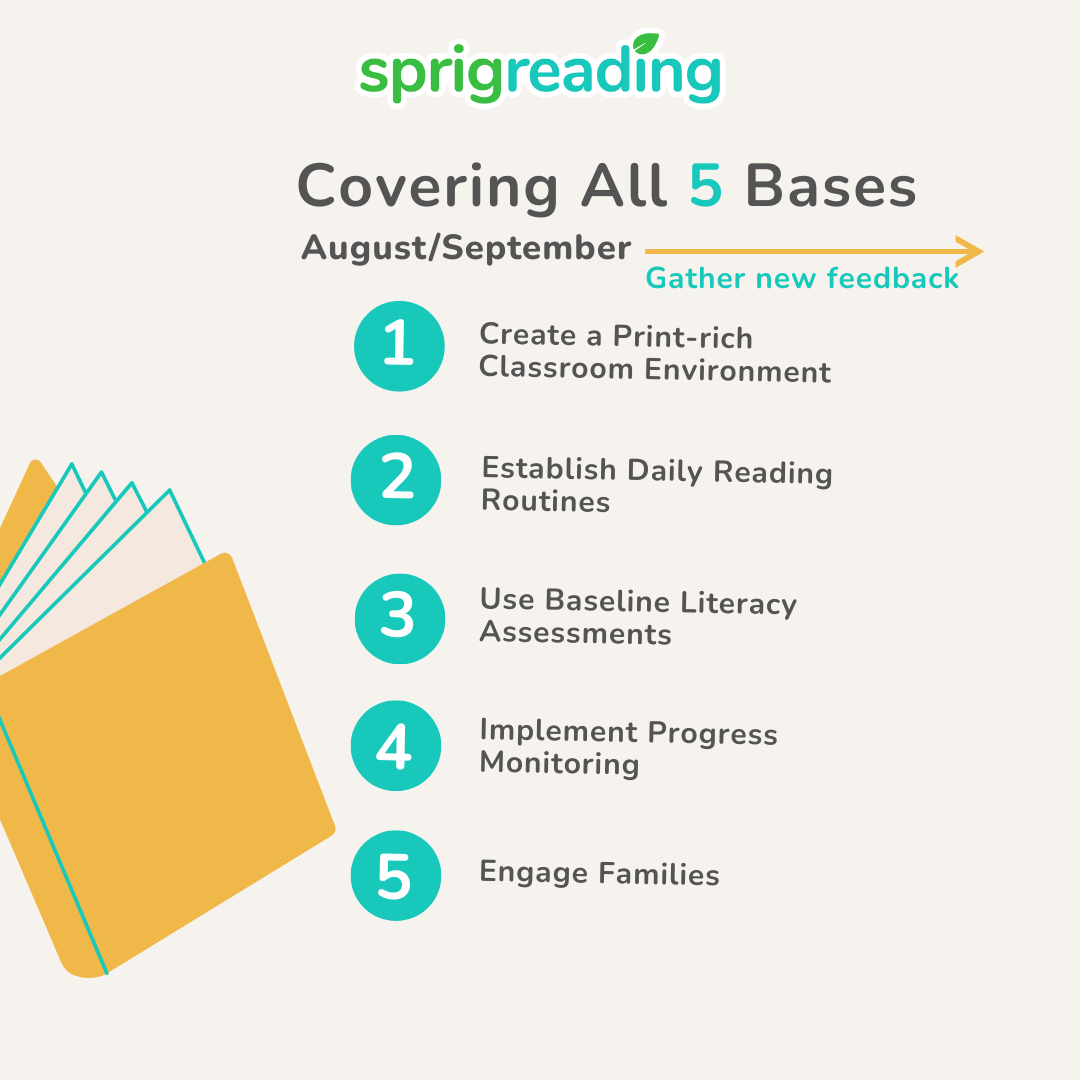
These five evidence-based strategies give teachers practical ways to build strong reading foundations from the get-go, setting students on a path to success throughout the year.
1) Create a Print-rich Classroom Environment to Support Early Literacy Development
A print-rich environment promotes exposure to letters and words and supports vocabulary and print concepts, key elements in early literacy instruction. Classrooms with different forms of print perform better than those without them.
By making text visible, meaningful, and interactive, teachers create daily opportunities for practice and reinforcement.
In the first month of school, this environment helps students quickly connect spoken and written language, laying the foundation for reading success and accelerating their confidence as emerging readers.
| Common Print-Rich Practices | Less-Thought-of Print-Rich Practices |
| Word walls with sight words. | Interactive bulletin boards where students add words, questions, or connections. |
| Anchor charts for phonics, vocabulary, and comprehension strategies. | Student-created class dictionaries or personal word journals. |
| Classroom library with decodable books. | Print-rich centers (For example, menus in pretend play areas, maps in exploration corner). |
2) Establish Daily Reading Routines to Build Foundational Literacy Skills
Consistent and explicit routines provide repeated and systematic exposure to core foundational reading skills, supported by evidence-based reading. Structured, short practice sessions fit classroom schedules and consistently move students forward.
In the first month, daily reading routines help students quickly establish familiarity with letter-sound relationships, vocabulary, and print concepts.
By embedding consistent practice from day one, teachers can build confidence and set the stage for measurable reading growth throughout the school year.
| Common Daily Reading Routines | Less-Thought-of Daily Reading Routines |
| Morning read-alouds with teacher modeling. | Daily “sound hunts” around the classroom where students find words with target phonemes. |
| Guided reading in small groups. | “Flash fiction” or short sentence strips for 3–5 minute fluency practice. |
| Letter-sound practice with alphabet cards. | “Word of the day” journal where students create sentences or find examples in class text. |
3) Use Baseline Literacy Assessments to Identify Student Reading Levels
Baseline data identifies who needs tier 1 differentiation vs. immediate tier 2 support. Quick, focused screenings let teachers prioritize instruction in the first month when intervention can have the highest return.
By starting early, teachers ensure that no instructional time is lost and that students get the right level of support before gaps widen.
Sprig Learning has always prioritized providing the right support for every early learner, across all tiers of instruction.
Early baseline checks also establish a benchmark for progress monitoring, making it easier to celebrate growth and adjust strategies as the year unfolds.
| Common Baseline Practices | Less-Thought-Of Baseline Practices |
| Screening with standardized tools (e.g., DIBELS, Acadience). | Informal teacher-student conferences to observe confidence, stamina, and motivation around reading tasks. |
| Oral reading fluency (for Grade 1–3). | Rapid automatized naming. |
| Phonological awareness tasks (For example, rhyme detection, syllable counting). | Error Analysis of Decoding Attempts. |
4) Implement Progress Monitoring Tools to Support Differentiated Reading Instruction
Progress monitoring produces measurable gains when used to inform instruction. Meta-analyses show a positive effect on reading and related outcomes when regular progress checks guide teaching decisions. Continuous monitoring fills the gaps between less-frequent screeners and diagnostic assessments.
In the first month of school, progress monitoring helps teachers move beyond just static baseline snapshots and start tracking early skill growth right away.
Quick, formative checks make it clear whether students are responding to instruction, allowing teachers to provide targeted support earlier, and then subsequently monitor those tier 1 interventions as well.
According to renowned early literacy scientist Linda Diamond, differentiating tier 1 instruction through flexible, skill-based grouping empowers teachers to target essential skills with precision. It ensures each student receives instruction aligned to their specific learning needs as identified by progress monitoring.
Sprig Learning is a strong proponent for monitoring every child’s progress, a commitment that inspired the creation of Sprig Reading.
| Common Progress Monitoring Practices | Less-Thought-Of Progress Monitoring Practices |
| Anecdotal notes during small group lessons. | Exit tickets for literacy (For example, students write/draw one sound, word, or idea they learned) |
| “Drop-in” progress checks during centers. (For example, listen to 3 students read for 2 minutes each) | Embedding monitoring into play-based tasks for K–1 (sorting sounds, labeling classroom items) |
| Frequent skill sampling (assess 2–3 different skills per week, rotating across students) | Gamified assessments (For example, word recognition “speed rounds”) where data is recorded for growth |
5) Engage Families in At-Home Reading Practices to Strengthen Classroom Literacy Learning
Family-implemented literacy interventions and consistent home reading routines increase vocabulary, decoding practice, and engagement. Recent reviews confirm positive effects on early literacy outcomes when families are given structured and simple activities to do at home.
Establishing these routines in the first month accelerates reading success by extending practice beyond school hours, multiplying exposure to foundational skills.
Partnerships between school and home amplify classroom gains, foster earlier progress, and build a classroom culture where effort and growth are visible and celebrated.
Sprig Learning has long championed strong partnerships between home and school, previously publishing the likes of 6 Amazing Parent Engagement Ideas in Early Learning.
| Common At-Home Reading Practices | Less Thought of At-Home Reading Practices |
| Parents/guardians labeling common household items with sticky notes for print exposure. | Sending home audio recordings of teachers modeling fluent reading for replay. |
| Visiting the library to borrow books. | Sending home word or letter scavenger hunts tied to classroom themes. |
| Leveraging daily routines (recipes, shopping lists, signs) as literacy moments. | Incorporating songs, rhymes, or chants at home to build phonological awareness. |
Grounded in The Strategic Approach: Seeing the Bigger Picture
Even when teachers apply all the right back-to-school literacy practices, initial results may still fall short of expectations. This is not because of a lack of effort or planning. Rather, it’s valuable feedback that points to what needs to change.
For example, if early Grade 2 or Grade 3 screeners show that the majority of students are behind research-based expectations, this signals a larger systemic concern. The school may need to revisit its curriculum, provide more targeted professional development and coaching, or invest in stronger instructional materials, according to Margaret Goldberg, literacy coach, and co-founder of Right to Read Project.
Visibility into early screening data across all grades ensures teachers are better prepared to meet student needs from day one. Measuring historical student data can provide even deeper insights, predicting swings in reading performance.
Equally important, strategies adopted in August and September should not be unalterable. If students are not moving up performance bands throughout the year, strategies must be scrutinized and adjusted.
At the heart of it all, one truth stands firm: high-quality classroom instruction in the early grades is the most cost-effective path to achieving equitable literacy outcomes for all students.
That’s why strategy is critical! By putting these practices into action from day one, teachers can establish a strong foundation that not only supports immediate progress but also sets the stage for lasting reading success for every student.