
Mastering the foundational reading skills from Pre-K through Grade 3 is one of the strongest predictors of a student’s early literacy success.
A significant body of research now tells us not just what to teach, but how to teach it.
We’ve explored both the ideal learning content and teaching activities before. We’ve also written on the different assessment types of the learned content.
In this blog, Sprig explores what evidence-based, systematic and explicit teaching practices look like in early literacy classrooms. It further explores how systems of support can better enable teachers to be more effective with those practices.
The best teaching practices in early literacy are evidence-based.
Evidence-Based Teaching Practice Defined

An evidence-based teaching practice is one that is supported by rigorous research showing it leads to improved student outcomes.
Evidence-based practice combines teacher experience, classroom observation and decades of research to guide decisions.
As stated in the introduction, they have to be applied to the foundational reading skills.
Let’s see what they look like in modern classrooms.
Core Evidence-Based Teaching Practices in Early Literacy

Below are research-validated classroom practices that support foundational reading skills:
1. Explicit Instruction
What it is: Teachers directly teach skills (e.g., phonics, phonemic awareness) rather than assuming students will pick them up indirectly.
The instruction follows a research-based scope and sequence with clear modeling and guided practice.
Why it matters: Meta-analyses show explicit and systematic teaching of foundational skills improves decoding, fluency, and comprehension more effectively than less structured approaches.
Beginning readers do not yet have the neural pathways to infer phoneme-grapheme relationships. Explicit instruction forms efficient reading habits early on.
2. Systematic Instruction
What it is: Instruction progresses in a planned order, from easier to more complex skills.
For example, phonemic awareness precedes phonics, which precedes fluent decoding and comprehension.
Why it Matters: Systematic phonics instruction is significantly more effective than random or incidental approaches in building word-reading skills.
Students require multiple successful retrievals of a skill across contexts before mastery.
Systematic instruction respects this skill dependency chain and ensures students know the required information to avoid costly interventions later on.
3. Modelling and Subsequent Guided & Independent Practice
What it is: Teachers show proficient strategies by thinking aloud, demonstrating decoding, comprehension strategies, or expressive reading.
Shared reading involves reading together to scaffold learners’ skills.
Why it Matters: Students learn not just what to do but how to do it by observing fluent readers in action.
After explicit modelling, students practice with teacher support (guided) and then independently.
Practice includes decoding with feedback, reading decodable texts, and structured activities.
4. Feedback and Correction
What it is: Teachers provide timely, specific feedback when students make errors, helping them understand why an answer is incorrect and how to improve.
Sometimes this takes the form of very early reading interventions.
Why it Matters: Immediate corrective feedback strengthens phonemic awareness, decoding accuracy, and fluency, reducing the likelihood of persistent errors.
Practice alone without support doesn’t guarantee skill acquisition, feedback and correction during practice significantly boost learning.
5. Application in Context
What it is: Students apply skills in meaningful contexts, such as reading connected texts after decoding practice and engaging with comprehension strategies like predicting or summarizing.
Why it Matters: Application should reinforce skills learned, not replace explicit teaching with guess-based strategies (e.g., three cueing, which research has challenged due to weak evidence).
Two common extremes to avoid are:
- Too isolated: Students practice skills endlessly without real reading
- Too contextual too soon: Students read texts before decoding skills are stable
Effective application strikes a balance.
6. Ongoing Assessment and Adaptation
What it is: Regular screening and progress monitoring help teachers tailor instruction to individual student needs. Assessments inform grouping, pacing, and targeted interventions.
Why it Matters: Reading development can be non-linear. Students can:
- Master phonics but struggle with phonemic awareness.
- Decode accurately but lack fluency.
- Comprehend orally but struggle with print.
Without regular and granular assessment, these patterns remain invisible.
Frameworks like Response to Intervention (RtI) or Multi-Tiered Systems of Support (MTSS) embed data use into daily practice so teachers can respond to student performance quickly.
7. Multi-Sensory Techniques (Where Appropriate)
What it is: Approaches like Orton-Gillingham use auditory, visual, and kinesthetic modalities simultaneously to teach and reinforce learning.
Why it Matters: Multi-sensory structured literacy professional learning programs like Brainspring’s Phonics First®, is particularly effective for students with reading difficulties and dyslexia, as it strengthens neural associations between sounds and symbols.
Thus it’s a more inclusive approach to give everyone the best chance at succeeding.
How Can These Practices Be Supported With Tools?
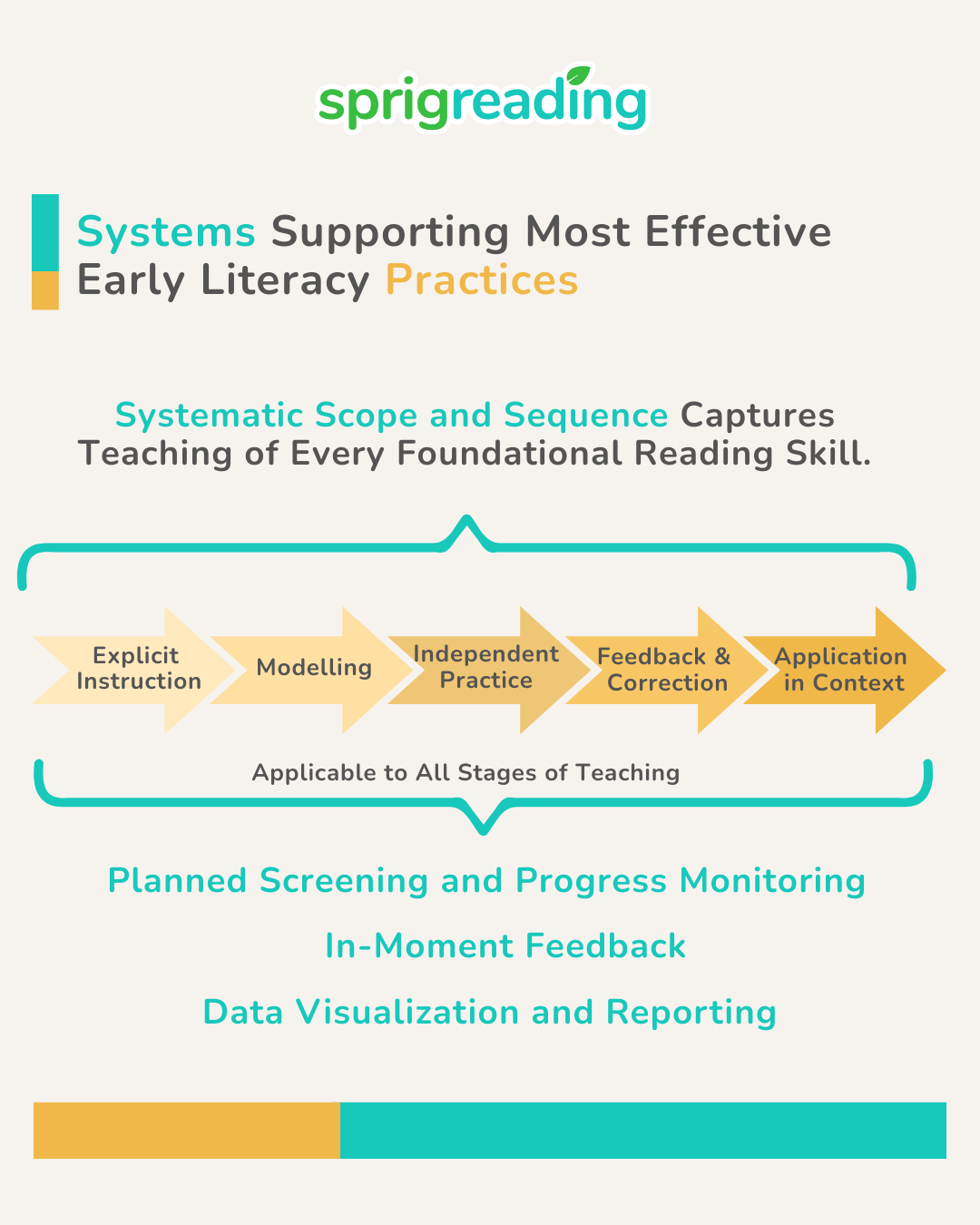
The classroom practices above are powerful on their own, but certain assessment and instructional support systems help teachers implement them more efficiently and consistently.
The following capabilities in a teacher support system help with all the aforementioned best-in-class teaching practices in early literacy:
1. Systematic Scope and Sequence
Tools with built-in scope and sequence help teachers ensure instruction is logical, cumulative, and aligned with evidence-based progression.
Teachers can follow systematic approaches without reinventing the scope and sequence.
2. Planned Screening & Progress Monitoring
Planned yearly screening and regular monitoring in between help teachers differentiate instruction, group students strategically, and know exactly when to intensify support.
Teachers can see who needs extra support now rather than waiting for end-of-unit tests.
3. Data Visualization and Reporting
Easy-to-interpret dashboards give teachers and leaders a clear picture of skill acquisition across phonemic awareness, phonics, fluency, vocabulary, and comprehension.
Clear dashboards allow teachers to form small groups, assign targeted practice, and monitor growth in real time.
4. In-Moment Feedback
Some tools capture notes, examples, and multimedia evidence linked directly to instruction, making feedback and planning more actionable and less time-consuming.
When teachers can take notes tied to instructional moments, feedback becomes more actionable.
A Smarter Way. Making it Super Easy To Implement The Best Teaching Practices.

Teachers are more likely to implement evidence-based teaching practices when they have tools that reduce workload and clarify next steps, reducing time spent on data entry and increasing time spent on instruction.
If you want a solution that supports explicit, systematic teaching, planning practice and application of master, and ongoing monitoring in one place, solutions like Sprig Reading can help!
This is achieved by integrating assessment data, instructional planning, and progress visualization.
Teachers can spend more time on teaching and less on paperwork.
Evidence-based early literacy is not a checklist. It is a way of thinking about instruction, one that prioritizes clarity, sequence, responsiveness, and sustainability.
When teaching practice aligns with how reading actually develops, student success follows.